Last updated 2026-08-19
TL;DR
Leaf guard is a gutter cover that keeps debris out of rain gutters. Starting this work means joining a home-improvement trade, not chasing a special national license. Confirm the contractor class your state and city already use, buy insurance that names gutter work, follow OSHA's 6-foot fall rule, and check EPA lead rules on pre-1978 houses. Start on paper. Confirm every fee with the board.
What is leaf guard?
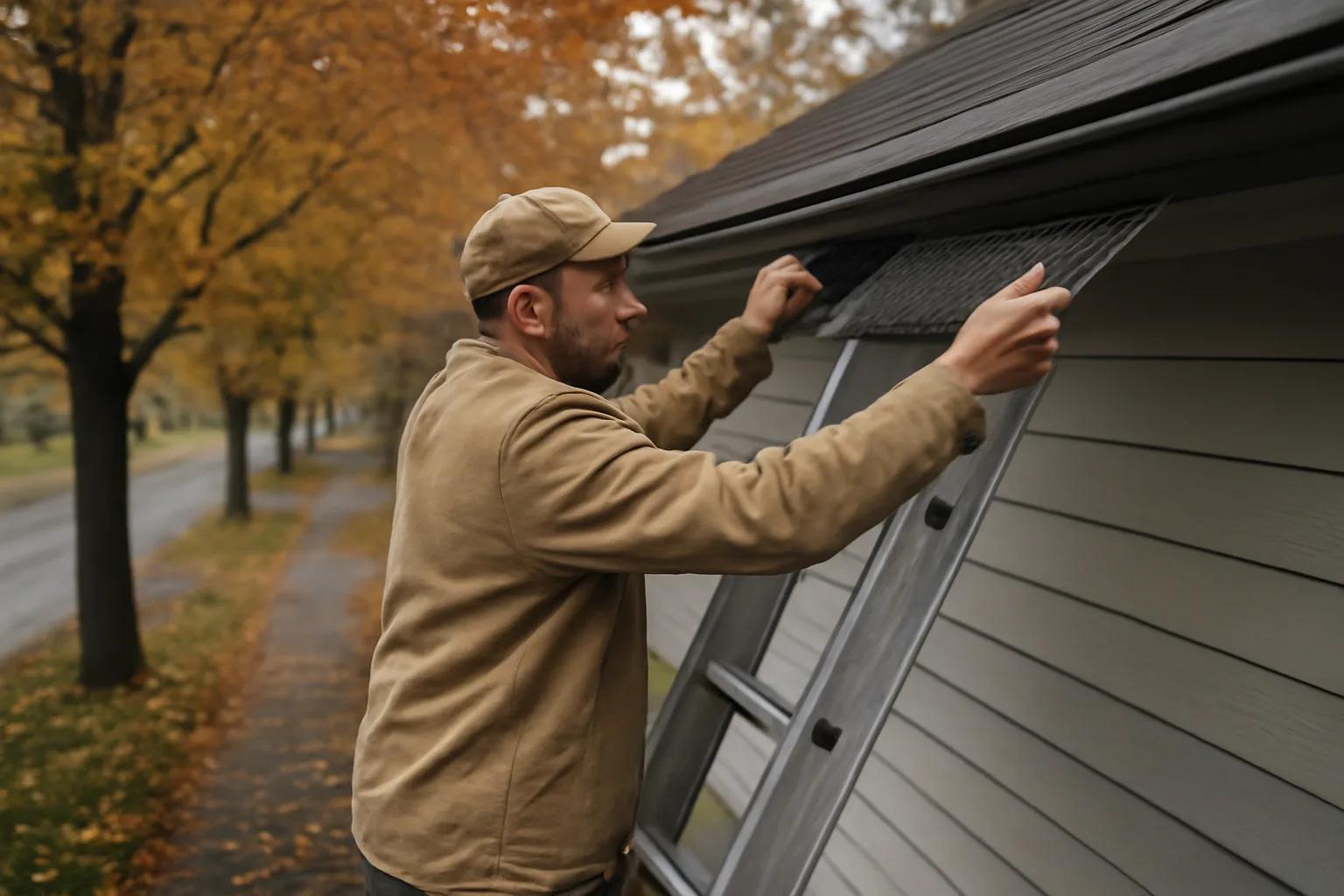
Leaf guard is a cover, screen, hood, or trough insert that sits on a rain gutter so leaves, needles, and shingle grit skip the channel while rainwater still enters. That is the product. People also use the same two words for the install trade, the sales pitch, and a few factory-branded gutter systems. The physics stay simple. Water needs a path off the roof, into a trough or over a hood, then out a downspout to soil or a drain that does not soak the foundation.
There is no federal leaf guard occupation.
You will not find a U.S. labor code that exists only for this product. You are doing gutter protection work. Building departments usually file that under home improvement, roofing, sheet metal, or general contracting. The product marketing is loud. The paper is borrowed from older trades.
Hood systems use a reverse curve so water is pulled in while debris slides off. Micro-mesh uses a fine screen. Foam and brush inserts sit in the trough and clog in their own way. Cheap snap-on screens are fast to install and fast to fail if the gutter sags. None of them fix a crushed downspout or a fascia that has already rotted. Fix the water path first, then talk about guards.
The International Residential Code says that unless roofs are sloped to drain over roof edges, roof drains shall be installed at each low point of the roof [10]. EPA's stormwater pages treat downspouts as drainage hardware you can aim so runoff soaks into soil [13]. That is the right mental model. You are moving water. You are not selling a promise that a house will never need a ladder again.
If a seller tells you leaf guard is its own licensed profession with a national board, walk away. The board you want is the contractor board you already have in your state.
How do you start leaf guard?
You start leaf guard on paper, not on a roof. Confirm the license class your state and city use for gutter and gutter-guard work. Form an entity if you want the liability split. Get an EIN if you will hire people or a bank wants one [8]. Buy insurance that names gutter work, not consulting. Write a one-page rule for ladders and fall arrest. Then pick one product you can warrant without lying.
The SBA start sequence is dull and it is still the right order. Plan the work, fund it, pick a structure, register the business, get tax IDs, then collect the licenses your location actually names [9].
Do not wait for a leaf guard commission. There is not one. Call the contractor licensing board, the home improvement commission, or the city building official. Ask a direct question. Is clipping a guard onto an existing gutter inside an existing license class, and does replacing the gutter change the answer? Ask whether your ads need the license number. Write down the person's name and the date.
Your first paid job should be a single-story ranch with firm soil and a short carry from the truck. A three-story colonial under pine trees is how people blow out a knee and then argue about stains on the siding. Learn callbacks on easy houses.
If you sell in the home, read the FTC Cooling-Off Rule before you print a contract. Many door-to-door and in-home sales of $25 or more give the buyer until midnight of the third business day to cancel [5].
Do you need a license to install leaf guards?
You need a license if your state or city already treats gutter or home-improvement work as licensed contracting. You do not need a special leaf guard card, because that card does not exist at the national level. Confirm the class with the board that already regulates contractors where you will work. Fees, tests, and experience hours change by board. I will not invent them.
Florida regulates construction contracting in chapter 489, Florida Statutes. Unlicensed contracting carries real penalties under section 489.127 [6]. California treats acting in the capacity of a contractor without a license as a crime. Business and Professions Code section 7028 says a person who "engages in the business of, or acts in the capacity of, a contractor, without having a license therefor" in connection with work that requires a license "is guilty of a misdemeanor" [7]. Texas does not run a statewide general contractor license for most residential jobs, but cities still issue permits and can stop a job. New York City licenses home improvement contractors through its consumer agency. Those four facts already tell you the map is local.
| Place | What the paper usually is | Who to call |
|---|---|---|
| Florida | State construction contractor rules under chapter 489 | Florida DBPR |
| California | CSLB contractor license (BPC 7028) | Contractors State License Board |
| Texas | No statewide general contractor card for most homes | City building official |
| New York City | Home improvement contractor license | NYC DCWP |
A clip-on guard on a sound gutter is sometimes treated as minor repair. Pulling the old gutter, hanging a new run, and adding a hood is more often full contractor work. Do not guess. The same board that fines unlicensed roofers will not care that you called it leaf guard.
If you advertise in a licensed state without the number the statute requires, you handed the investigator the exhibit. Put the number on the truck after you have the card, not before.
What insurance do you actually need in year one?
You need general liability that lists gutter and exterior water-control work, plus commercial auto if a truck is in the business name. If you have employees, you almost always need workers compensation. Tools on a truck want inland marine or an installation floater, not a hope that a homeowner policy cares. An umbrella can wait until the revenue is real. Read when an umbrella policy can wait after the primary policies are bound.
The policy is only as good as the class codes and the written description of operations. Handyman on a gutter-guard shop is how a carrier denies a fascia claim. Read what general liability actually covers before you bind anything. If you will have W-2 help, read workers comp questions the same week.
Certificates of insurance are how general contractors and some homeowners let you on the property. Learn the mechanics in how certificates of insurance work. Do not alter a cert. That is a great way to lose the policy you do have.
Skip cheap internet policies that exclude heights, roof work, or construction. You work at height. Say so. For the truck and the tool bags, auto and tools coverage is the next page to read, not a forum thread.
What equipment do you need to install gutter guards?
You need two Type I or IAA extension ladders (the duty rating is on the rail), a stand-off stabilizer, a harness and an anchor you were trained to use, snips, a screw gun, a hose, a wet/dry vac, gloves, and marked eye protection. A folding scaffold helps on ranch fascia. That is enough to do honest work.
A wrap on a new truck in month one is a waste. So is stocking three competing meshes so the customer can choose. You will mix screws, mix warranties, and lose the plot. Buy one system whose fasteners you understand.
OSHA's ladder rule is not a suggestion on a job that is construction work. 29 CFR 1926.1053(b)(1) says that when portable ladders are used for access to an upper landing surface, "the ladder side rails shall extend at least 3 feet (.9 m) above the upper landing surface to which the ladder is used to gain access" [2]. People skip this and then slide the last two rungs. Do not.
If you cannot name the anchor point, you are not ready for a two-story eave. Stay on the ladder jobs you can do without inventing a tie-off.
How much does it cost to start a leaf guard shop?
I will not publish a fake national startup total. License fees, application charges, and insurance deposits move by state, by your driving record, and by whether you have employees. Confirm every dollar with the board and the carrier. The honest first kit is a reliable used truck, two good ladders, fall gear, a basic tool bag, entity papers, an EIN if you need one [8], and a liability policy that does not exclude the work.
The money pit is inventory you cannot return and leads you cannot close. Buy guards by the job from a supplier that will take unused boxes back in season. Do not pre-buy a garage full of foam because a webinar said fall was coming.
LeafGuardPath sells a $149 one-time Product-Choice + Pitch Kit at /start if you want a paper checklist. You do not need it to follow anything in this guide.
Spend first on the policy and the license, then on the ladder that will not flex. A vinyl wrap can wait until you are tired of explaining the faded magnetic sign. If a class or a coach promises a quota, a reserved territory, or a fixed approval date, treat that as fiction. Boards approve on their own timeline, and nobody can promise you a card in advance.
What safety rules apply on the roof and ladder?
If the job is construction work, OSHA's construction fall rule applies. OSHA 29 CFR 1926.501 requires fall protection at 6 feet on construction walking surfaces [1]. The text is blunt. Section 1926.501(b)(1) says "each employee on a walking/working surface (horizontal and vertical surface) with an unprotected side or edge which is 6 feet (1.8 m) or more above a lower level shall be protected from falling by the use of guardrail systems, safety net systems, or personal fall arrest systems" [1]. That sentence is the argument for a harness on a two-story roof deck.
BLS counted 5,486 fatal work injuries in 2022, and 865 of those deaths were falls, slips, or trips [12]. Gutter work lives in the same height band.
OSHA 3146 (Fall Protection in Construction) walks through the systems the standard allows [11]. Read it once. Then write three sentences your helper can repeat. When we go over 6 feet on a roof surface we tie off. We do not walk the gutter like a balance beam. We do not move a ladder while someone is on it.
Ladders have their own section at 29 CFR 1926.1053, including duty rating and that 3-foot extension above a landing [2]. The top cap is not a step.
If you are a true one-person shop, OSHA still writes rules for construction employers, and your state plan may be stricter. A fall will not care about your entity type. Budget time for the gear, more than the cost of the gear.
Do old houses trigger lead paint rules?
They can. EPA's RRP rule applies to renovation work that disturbs lead-based paint in housing built before 1978 [3]. Screwing into painted fascia, scraping a bead, or replacing a painted gutter run can be that disturbance. The detailed duties live in 40 CFR Part 745, Subpart E [4].
If the house is pre-1978 and you will disturb paint, you need the firm certification, a certified renovator on the job, the lead pamphlet in the owner's hand, and the work-practice rules. Confirm current firm fees and course providers on EPA's program page. I will not invent a fee.
Post-1978 siding with a clean fascia is a different day. Still photograph the paint condition before you lean a ladder on it. Arguments about chips start after the truck leaves.
If a lead inspector already tagged the trim, stop and get the paper trail right. Guessing is how you buy a cleanup you cannot afford.
How do you price a leaf guard job?
Price the job from your supplier invoice, your real hours (setup, install, haul-off, and the return trip), dump fees, fuel, and a callback reserve. Per linear foot is how most residential buyers compare quotes. I will not invent a national installed price. Those blogs recycle each other and they ignore rotten fascia.
The FTC Cooling-Off Rule gives buyers until midnight of the third business day to cancel many in-home sales of $25 or more [5][14]. Put the cancel notice in the contract the way the rule describes. A handshake on the porch is how you fund a chargeback.
Do not bundle a long labor promise you cannot staff. Match the labor warranty to how long you will still answer the phone. Product warranties come from the manufacturer. Say which is which on page one.
Read claims that sink a first-year shop before you write a warranty paragraph that your policy will not defend.
What paperwork should you keep from day one?
Keep the signed contract, the cooling-off notice if the rule applies, change orders, before and after photos, the license number as you advertised it, invoices, payment records, and dump receipts. If you used a 1099 installer, keep the W-9 and the reason you thought they were independent. The Department of Labor cares about who controls the work [15].
Take a photo of the pitch of the gutter and the discharge point. That photo wins the it overflowed in the first storm call.
Store it where you can find it in two years. A tote in the shop beats a text thread with a supplier.
If your state requires the license number on every ad, screenshot the ad. Investigators print the Facebook post.
What is a waste of money in the first year?
A reserved national territory is a waste of money because it is not real. So is a garage of mixed product you cannot warrant the same way. Skip the lead mill that sells the same phone number to three crews. Skip the coach who sells you a script and no statute.
Do not cheap out on the harness or the ladder rating. Do not classify a helper you dispatch, train, and schedule as a pure 1099 if you control the means of the work [15]. That savings comes back as a premium audit or a wage claim.
A second product line in month two is usually anxiety, not strategy. Get 20 clean jobs through one system.
Magnetic signs are fine. A wrapped van you finance at a painful rate is not.
How do you confirm rules with your state board?
Call the contractor or home improvement board and ask which classification covers gutter-guard install and which covers full gutter replacement. Ask if advertising the work without that class is unlicensed contracting. Ask when a permit is required. Write the answers down.
Then call the city building official for the towns you will work. Boards and cities do not always agree about clip-on accessories. The city can still stop the job.
Confirm fees, bond amounts, and testing with that board. Those numbers move. Anyone who publishes a live fee in a blog and never updates it is guessing.
Florida's chapter 489 and California's BPC 7028 are the kind of statute pages you can read yourself [6][7]. Start there, then ask the board how they apply them to guards versus new gutter runs.
What does first-year leaf guard work actually look like?
Fall is busy because leaves are visible. Late winter is callbacks and ice. Summer is the time you should be photographing fascia rot that fall customers will blame on you. Plan cash for the quiet months.
Refuse the job when the fascia is soft, the decking is a trampoline, or the eave is three stories with no tie-off you trust. A declined job costs nothing. A fall costs everything you just built.
Match color only after you hold a real sample on the existing gutter in daylight. Indoor LED lies.
Near the end of year one, reread your contracts and your certificates. Then decide if you even want employees. If you do, restart the workers comp and misclassification reading before the first hire.
LeafGuardPath is an independent publisher, not a law firm and not a crew. Use /start only if you want the kit. Confirm every board fact with the board.
Frequently asked questions
What is leaf guard?
Leaf guard is a cover, screen, hood, or insert fitted to a rain gutter so debris skips the trough while water still enters. The same phrase is used for the install trade. It is gutter protection work, not a separate federal occupation. Building departments usually file it under home improvement, roofing, sheet metal, or general contracting. Confirm the local class before you advertise.
How do you start leaf guard?
Start on paper. Confirm the contractor or home improvement class your state and city already use for gutter work, register the business, get an EIN if you need one, and buy insurance that names the real work. Add a written ladder and fall rule. Then take easy single-story jobs. There is no national leaf guard board to wait on.
Is there a national leaf guard license?
No. There is no national leaf guard license and no federal leaf guard commission. You use the contractor, home improvement, or specialty class your state and city already issue. Florida chapter 489 and California BPC 7028 are examples of real contractor statutes. Confirm the classification, fees, and advertising rules with the board that will actually fine you.
Can I install leaf guards under a handyman exemption?
Only if your state or city still has a minor-work exemption that covers the exact job, dollar amount, and advertising you plan. Clip-on guards and full gutter replacement are often treated differently. Exemptions change. Do not trust a Facebook summary. Ask the contractor board and the city building official, and get the answer in writing if you can.
Do OSHA rules apply if I work alone?
If the job is construction work, OSHA's construction standards still describe the fall and ladder rules employers must follow, and state plans can be stricter. OSHA 29 CFR 1926.501 sets a 6-foot trigger on unprotected edges. A one-person LLC does not make a two-story eave safer. Budget for the harness, the rated ladder, and the 3-foot landing extension.
Do I need workers compensation for a helper?
If the helper is an employee, most states require workers compensation. Calling someone a 1099 installer does not settle it if you set the hours, train the method, and dispatch the jobs. The Department of Labor looks at control of the work. Confirm the employee count trigger with your state workers comp agency before the first hire.
Does a clip-on guard need a building permit?
Sometimes no, sometimes yes. A clip-on accessory on a sound gutter is often treated as minor work. Replacing the gutter run, altering drainage, or working in a historic district is more likely to need a permit. The contractor board and the city building official can disagree. Call both. Do not assume the product brochure settles the permit question.
Do pre-1978 houses change the job?
Yes, if you will disturb paint. EPA's RRP rule covers renovation that disturbs lead-based paint in housing and child-occupied facilities built before 1978. Fascia screws and gutter replacement can count. You then need firm certification, a certified renovator, the pamphlet, and lead-safe practices. Confirm current fees on EPA's RRP program page.
Does the FTC 3-day cancel rule apply to my quote?
It can, if you close a covered sale at the home, workplace, or a temporary location and the purchase is $25 or more. The FTC Cooling-Off Rule (16 CFR 429) gives many buyers until midnight of the third business day to cancel. A quote that is not a contract is different from a signed in-home sale. Read the rule before you print forms.
Should I offer a lifetime warranty?
Not in year one unless you truly mean you will still answer that phone. Split product coverage (from the manufacturer) and labor coverage (from you). A lifetime labor line you cannot staff is how you fund free revisits forever. Write the limit in the contract. Read your general liability form before you promise damage you are not insured to repair.
Do I need an EIN to start?
You need an EIN if you will have employees, if you form certain entities, or if a bank or carrier asks for one. Sole proprietors with no employees can sometimes use a Social Security number, but many shops get an EIN anyway. The IRS issues EINs online at no charge. Confirm your structure with a tax pro before you file.
Are foam and brush inserts worth selling?
Usually as a cheap add-on, not as your main system. They sit in the trough, hold grit, and still need service. Micro-mesh or a hood you understand is easier to warrant. If you stock foam, say out loud that pollen and shingle granules will pack it. Do not sell it as a never-clean product. That callback will eat the margin.
Can I 1099 my entire install crew?
Only if they are actually independent. If you set the schedule, supply the method, brand the truck, and control the work, wage agencies and your workers comp auditor may treat them as employees. The DOL misclassification page is the federal starting point. State tests can be stricter. Get advice before you build a crew on a 1099 habit.
What insurance should I buy first?
Bind general liability that names gutter and height work, then commercial auto if the truck is in the business. Add workers compensation when you have employees. Tools need an inland marine or floater, not a shrug. Skip policies that exclude roof or construction work. Confirm limits and exclusions with the carrier. Do not invent a certificate.
Sources
- OSHA 29 CFR 1926.501 Duty to have fall protection: Construction employees on unprotected sides or edges 6 feet or more above a lower level must be protected by guardrails, safety nets, or personal fall arrest.
- OSHA 29 CFR 1926.1053 Ladders: Portable ladders used to reach an upper landing must have side rails extending at least 3 feet above that landing.
- EPA Lead Renovation, Repair and Painting Program: RRP covers renovation that disturbs lead-based paint in housing and child-occupied facilities built before 1978.
- eCFR 40 CFR Part 745 Subpart E (RRP): 40 CFR 745 Subpart E sets firm certification, renovator, and work-practice duties for covered renovations.
- eCFR 16 CFR Part 429 Cooling-Off Rule: The Cooling-Off Rule covers certain in-home and temporary-location sales and requires a cancellation notice.
- Florida Statutes 489.127 (2023): Florida chapter 489 imposes penalties for unlicensed construction contracting.
- California Business and Professions Code 7028: Acting as a contractor without the required California license is a misdemeanor under BPC 7028.
- IRS Apply for an Employer Identification Number (EIN) online: The IRS issues EINs online for businesses that need an employer identification number.
- U.S. Small Business Administration, 10 steps to start your business: SBA's start sequence covers planning, funding, structure, registration, tax IDs, and licenses.
- ICC International Residential Code 2021 Chapter 9 Roof Assemblies: Unless roofs slope to drain over the edges, roof drains are required at each low point of the roof.
- OSHA Publication 3146, Fall Protection in Construction: OSHA 3146 explains fall protection systems allowed under the construction standard.
- BLS Census of Fatal Occupational Injuries, 2022 news release: BLS counted 5,486 fatal work injuries in 2022, including 865 falls, slips, or trips.
- EPA Soak Up the Rain: Rain Barrels and Downspouts: EPA treats downspouts as drainage hardware you can direct so runoff soaks into soil.
- FTC Buyer's Remorse: The FTC's Cooling-Off Rule: The FTC Cooling-Off Rule gives buyers until midnight of the third business day to cancel many in-home sales of $25 or more.
- U.S. Department of Labor, misclassification: DOL evaluates whether workers labeled as independent contractors are employees based on control of the work.